I help E-Commerce and B2B brands turn marketing spend into compounding revenue.
AI and Growth Marketing Consultant | Fractional CDO
AI SEO: Get Found in Google, ChatGPT, and AI Search Results
Search is splitting in two. Your customers still use Google, but a growing share now asks ChatGPT, Perplexity, and Gemini for recommendations. Most websites are optimised for neither the new AI engines nor Google's own AI Overviews.
AI SEO covers both sides: making your brand the answer AI assistants give when your buyers ask, and keeping your Google rankings strong as AI Overviews reshape the results page. Early movers here are building an advantage that will be very hard to catch.
Get an AI Visibility AuditWhat AI SEO Includes
A complete programme covering AI answer engines, Google AI Overviews, and the content structure both reward.
AI Visibility Audit
Where does your brand appear today when buyers ask ChatGPT, Perplexity, Gemini, and Copilot about your category? A baseline report with competitor comparison and citation gaps.
Answer Engine Optimisation
Structuring content so AI assistants cite you: clear entity signals, quotable passages, structured data, and the authority markers language models weight heavily.
Google AI Overviews Strategy
Adapting your pages to earn placement inside AI Overviews instead of losing clicks to them: question-led structure, concise answers, and supporting depth.
Entity and Schema Architecture
Person, Organisation, Product, and FAQ schema built out so both search engines and AI models understand exactly who you are and what you sell.
AI-Assisted Content Operations
Using AI to scale content production without the generic AI voice: human-edited workflows, original data insertion, and quality controls that protect rankings.
Measurement and Reporting
Tracking AI citations, AI referral traffic, and Overview appearances alongside classic rankings so you can see the full picture monthly.
How AI Answer Engines Choose What to Cite
Understanding the selection step explains almost every tactical difference between AI SEO and ordinary SEO.
An answer engine is not ranking pages, it is assembling a response, and it will only include something it can stand behind. That makes the decisive question different from the one Google asks. Google asks which page best matches this query. A generative system asks whether it can safely say this out loud.
The practical consequence is that verification beats persuasion. A page written to convince a human reader, full of confident claims with nothing behind them, gives an answer engine nothing it can check. A page that states specific facts, attributes them, marks them up cleanly and is corroborated by sources outside your control gives it everything.
This is also why brands with modest search visibility sometimes appear in generated answers while much larger competitors do not. The larger competitor may have more links and more traffic, and still be harder to verify: inconsistent business information, claims that appear nowhere else, and pages that are difficult to parse. Consistency and corroboration are doing the work, not authority.
What Changes, and What Does Not
Most of what already works keeps working. The additions are narrower than the amount of noise around this subject suggests.
What carries over unchanged
Crawlability, clean information architecture, genuinely useful content, internal linking and page speed. Answer engines read the web through the same basic mechanics. A site that is hard for a crawler to read is hard for a model to use, and no amount of AI-specific tactics compensates for that.
What matters more than it used to
Entity consistency, structured data, named and credentialed authorship, and being described accurately by sources you do not own. These were always good practice and moderately rewarded. In generated answers they are closer to prerequisites.
What is genuinely new
Being cited without being visited. You can influence a purchase decision and see nothing in analytics, which breaks the feedback loop most teams rely on. Checking directly whether you appear becomes a routine task rather than an occasional curiosity.
What does not work
Writing for the model rather than the reader, stuffing text intended only for machines, and the various formats sold as making content AI-ready. None of it survives contact with how these systems actually select sources, and some of it actively harms the human-facing page.
Where AI Visibility Pays Fastest
The gap between how much a category is researched through assistants and how well its businesses are set up for it is very uneven. Some sectors are worth acting on now.
Dental and healthcare practices
Patients ask assistants for recommendations constantly, and most practices have never checked whether they are named. The trust signals these systems look for are ones a real practice already has and simply has not published. The detail is in AI SEO for dentists and how to check whether AI recommends your practice.
Regulated financial services
Assistants are unusually cautious here and selective about sources, which favours firms that publish specific, attributable, maintained content. That is exactly what a working compliance process produces. See insurance and BFSI SEO.
Local service businesses
A generated answer often becomes the shortlist, and the shortlist is drawn from consistent business information and corroborating sources rather than from your website copy. Covered in local SEO.
Considered purchases with long research
Vehicles, insurance, healthcare and professional services all involve weeks of questions before a decision. Every one of those questions is now a place an assistant can answer without you. See automotive SEO and healthcare SEO.
How I Run AI Visibility Work
The AI visibility checklist:
- The questions your buyers ask, run through the major assistants and recorded
- Business information identical everywhere it appears, including old listings nobody remembers creating
- Structured data present, accurate and matching the visible page
- Named authors with verifiable credentials on anything substantive
- Visible review and update dates on content that can go stale
- Direct answers to real questions, high on the page, quotable without distortion
- Independent sources describing you accurately, not just linking to you
- A scheduled re-check, because the answers move
The Questions That Decide Whether You Appear
AI visibility work starts with the questions your buyers ask, not with keywords. They are not the same list and the difference matters.
Keyword research captures how people type into a search box: short, compressed, often two or three words with the grammar stripped out. People do not talk to an assistant that way. They ask full questions, they include their situation, and they follow up. A buyer who would have typed two words into Google will describe their circumstances in a sentence and ask what they should do.
That changes what you need to know. The useful input is not a ranked list of phrases by volume, it is the twenty or thirty real questions that sit between somebody having a problem and choosing a supplier. Your sales team already knows them, because they answer them on the phone every week. So does anyone who handles support or enquiries.
Once you have that set, the work becomes concrete. Run each question across the major assistants. Record whether you are named, who is named instead, and whether what is said about you is accurate. It is a manual exercise and it is the most useful two hours available, because it replaces speculation about AI search with a specific list of gaps.
Problem questions
What somebody asks before they know what they need. These are where assistants are most used and where being the source that explains it clearly earns a mention long before any purchase intent appears.
Comparison questions
How two approaches or two types of provider differ. Assistants answer these constantly, and they draw on whoever explained the trade-off most clearly rather than whoever ranks highest.
Recommendation questions
Who should I use, what are the good options, who is best for my situation. The highest-stakes category, because the answer is a shortlist and being absent from it is invisible in your analytics.
Verification questions
Is this provider any good, what do people say, are they properly qualified. Answered almost entirely from sources you do not control, which is why reviews and third-party coverage sit inside this work rather than beside it.
Why Most AI SEO Advice Is Currently Wrong
This field has more confident advice than evidence behind it, and a lot of what is being sold does nothing. It is worth being specific about which parts, because the wasted effort is substantial and it crowds out work that would help.
How Businesses Lose Here Without Noticing
These are the patterns I find most often, and none of them show up in a standard analytics review.
Contradicting yourself across the estate
A different business description on your site, your profiles and old directory entries. Each version is plausible, none agrees, and the result is a source that cannot be relied on. This is the most common and most fixable problem in the category.
Claims with nothing behind them
Confident marketing statements that appear nowhere else and cite nothing. A human reader discounts them. A generative system simply will not repeat them, which means your strongest selling points are the parts least likely to be mentioned.
Anonymous expertise
Substantial content with no author, no credentials and no review date. In health, finance and legal categories this alone is enough to keep a source out of generated answers. See healthcare SEO for how far this goes in regulated categories.
Never checking
The quiet one. A business can lose a share of its shortlist appearances over a year and see nothing unusual in its reporting, because the visits that never happened leave no trace. Checking directly is the only way to know, as set out in the AI visibility audit method.
AI SEO Questions
Is AI SEO different from normal SEO?
It builds on the same foundations: authority, clear structure, and genuinely useful content. The difference is optimising for how language models select and cite sources, which rewards entity clarity, quotable answers, and structured data more heavily than classic ranking factors alone.
Can you measure traffic from ChatGPT and Perplexity?
Yes. AI assistants pass referral data that can be segmented in GA4, and citation tracking tools show where your brand appears in AI answers. It is early-stage measurement, but it is measurable and growing quarter over quarter.
Should I wait until AI search matures?
The opposite. AI assistants build their picture of your category now, and brands cited early tend to keep getting cited. Waiting means letting a competitor become the default answer.
Related services: SEO Services, AI Marketing, Content Marketing
20 Years Across the Industries That Teach You Different Lessons
Every sector breaks growth in its own way. Click any industry for the full story of what I learned there and how it works for clients like you.
Ready to Grow Your Company?
Thirty minutes, one on one. I'll review your current setup, identify the growth opportunities you're sitting on, and give you honest, actionable advice tailored to your business. No sales pitch, just a real conversation about what to fix first.
Schedule a CallYour 30 minutes, mapped:
You keep the findings either way. Whether we work together is a separate conversation.
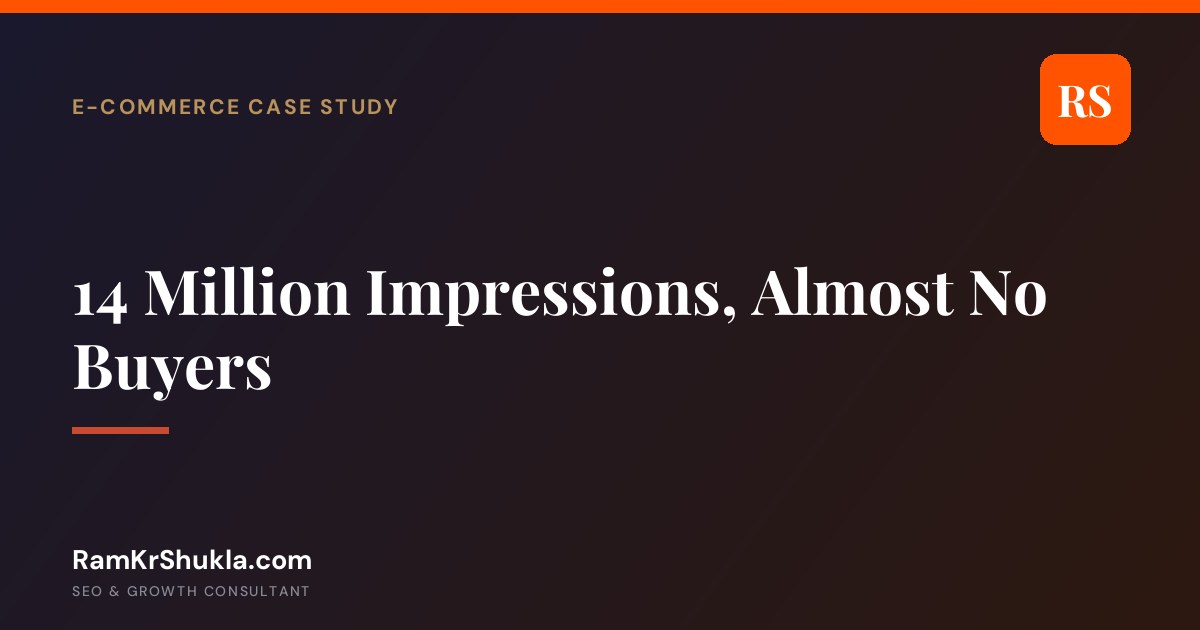
The Blog With Fourteen Million Impressions and Almost No Buyers
Fifteen million monthly impressions at a third of a percent click-through. The traffic was real, the audience was wrong, and fixing it meant deliberately losing most of it.