
SEO Strategy. Sequencing
Technical SEO First, Content Second: The Order Most Enterprise Teams Get Backwards
The most expensive mistake in enterprise SEO is not doing the wrong things. It is doing the right things in the wrong order. I have seen teams pour budget into content while the technical foundation underneath could not rank any of it, then conclude SEO does not work. The work was fine. The sequence was fatal.
Why Order Decides Outcome
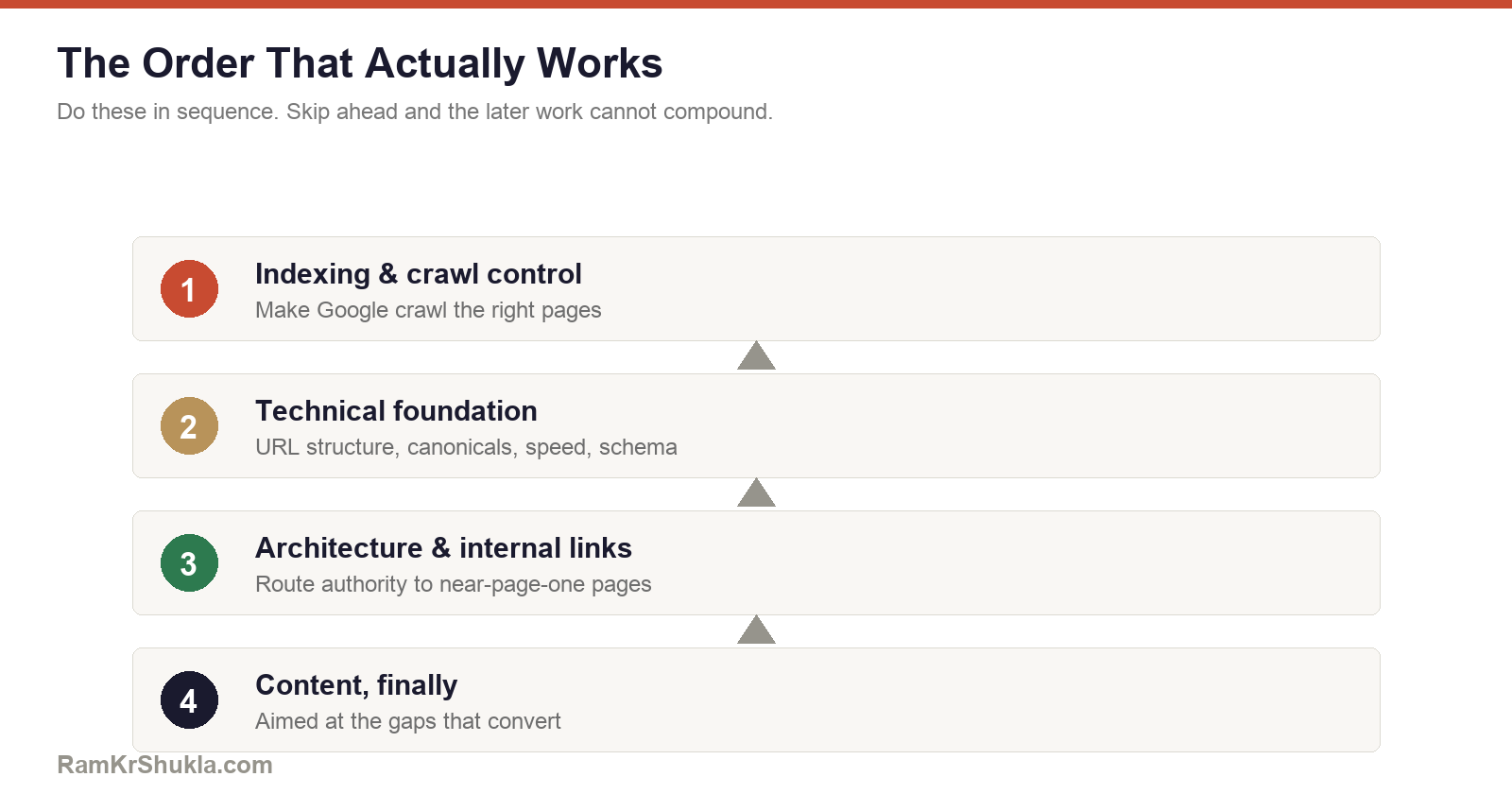
SEO initiatives are not independent. They depend on each other, and some are prerequisites for others actually paying off. Build content on a site with broken indexing and the content joins the pile of pages Google never surfaces. Chase rankings while cannibalisation splits your signal and you fight yourself. Scale pages before fixing speed and every new page inherits the same ceiling. The right work in the wrong order produces motion without progress, and burns the budget and the patience you needed for the work that matters.
“Doing the right things in the wrong order produces motion without progress. On a large site, sequencing is where the consultant earns the fee, because everything is connected and order decides outcome.”
Ram Kr Shukla, SEO and Growth Consultant
The Sequence That Works
This is why a serious enterprise SEO strategy is a prioritised backlog, not a list of ideas. Dozens of technical initiatives, each tagged by theme and quarter, shipped in an order that respects the dependencies. The order is not administrative detail. It is the strategy itself, and it is the difference between a program that compounds and one that spins.
If your SEO has been busy but flat, before you commission more content, ask a harder question: can the pages you already have actually rank? If the technical foundation cannot lift them, more content is the most expensive way to stay in the same place.
What Happens When You Skip the Order
The cost of wrong sequencing is not abstract. Ship content onto a site with broken indexing and the pages join the crawl-budget graveyard, unseen, and you conclude your content is not good enough when the truth is Google never rendered it. Chase rankings while cannibalisation splits your signal and you spend months watching two of your own URLs trade places on page two, neither ever reaching page one. Scale the catalogue before fixing site speed and every new page inherits the same slow ceiling, so the more you publish the more mediocrity you own. Each of these is a real failure mode I have been called in to reverse, and in every case the underlying work was competent. Only the order was wrong.
The Backlog Is the Strategy
A serious enterprise SEO plan does not look like a content calendar. It looks like a prioritised technical backlog: dozens of specific initiatives, each tagged by theme, owner, and quarter, sequenced so dependencies are respected. Structured data before content that relies on it. Cannibalisation fixes before ranking pushes. Speed and crawl control before scale. The document that matters is not a list of ideas, it is an ordered queue, and maintaining that order under pressure, when everyone wants the visible content win now, is a large part of what a consultant is actually for.
The test for whether your SEO is sequenced or scattered is simple. Ask why the current priority is the current priority. If the answer is that it unblocks the next thing, you have a sequence. If the answer is that it seemed worth doing, you have a to-do list, and on a large site a to-do list produces motion without progress.
How I Build the Sequence for a New Site
A sequencing strategy is not a philosophy, it is a document, and building it follows the same order every time. The point is to end with a queue where every item exists because it unblocks the next one, not because it seemed worth doing.
The Signals That Your SEO Is Scattered, Not Sequenced
You do not need an audit to sense when sequencing has gone wrong. The symptoms are consistent, and once you have seen them a few times they are hard to miss.
Signs your SEO is a to-do list, not a sequence:
- You cannot say why the current priority is the current priority beyond that it seemed worth doing
- Content is going out onto a site whose indexing and speed have never been audited
- Two of your own URLs have been trading places on page two for months and nobody has addressed the cannibalisation
- Every new initiative is additive; nothing is ever sequenced behind a prerequisite
- Effort is high and steady, but the results line is flat, the classic signature of motion without progress
If more than one of those is true, the problem is almost never effort and almost never talent. It is order. Fixing the sequence, not adding to the pile, is what turns the same work into results.
None of this means content does not matter. It means content is the reward for a foundation that can carry it, not a substitute for building one. The teams that compound are the ones patient enough to fix the machine first and disciplined enough to hold the order when the pressure to publish arrives. That patience, more than any single tactic, is what separates SEO that grows from SEO that merely stays busy. It’s also why any honest answer to how long SEO takes starts with the fixes.
Related reading: index bloat and crawl budget, international SEO, and the position 11-100 trap. This is the core of my technical and enterprise SEO work. Also worth reading: how to check your brand’s AI visibility in ChatGPT.
Busy SEO, flat results?
It is usually a sequencing problem, not an effort problem. I audit what is actually capping your growth and give you the ordered plan that turns motion into progress.
Get an SEO AuditTechnical SEO ServicesOne of the highest-return early fixes in any sequence: diagnosing and fixing keyword cannibalisation.
Tags: Technical SEOSEO StrategyEnterprise SEOSequencing