
Technical SEO. Crawl Economics
Index Bloat: Why Your Biggest SEO Problem Might Be Having Too Many Pages
Most site owners believe more indexed pages is better. On large sites, the opposite is usually true. Index bloat, thousands of low-value URLs crawled and indexed, is one of the most common and least understood problems in enterprise SEO, and I have watched it quietly cap sites that were doing everything else right.
How Bloat Happens, and What It Costs
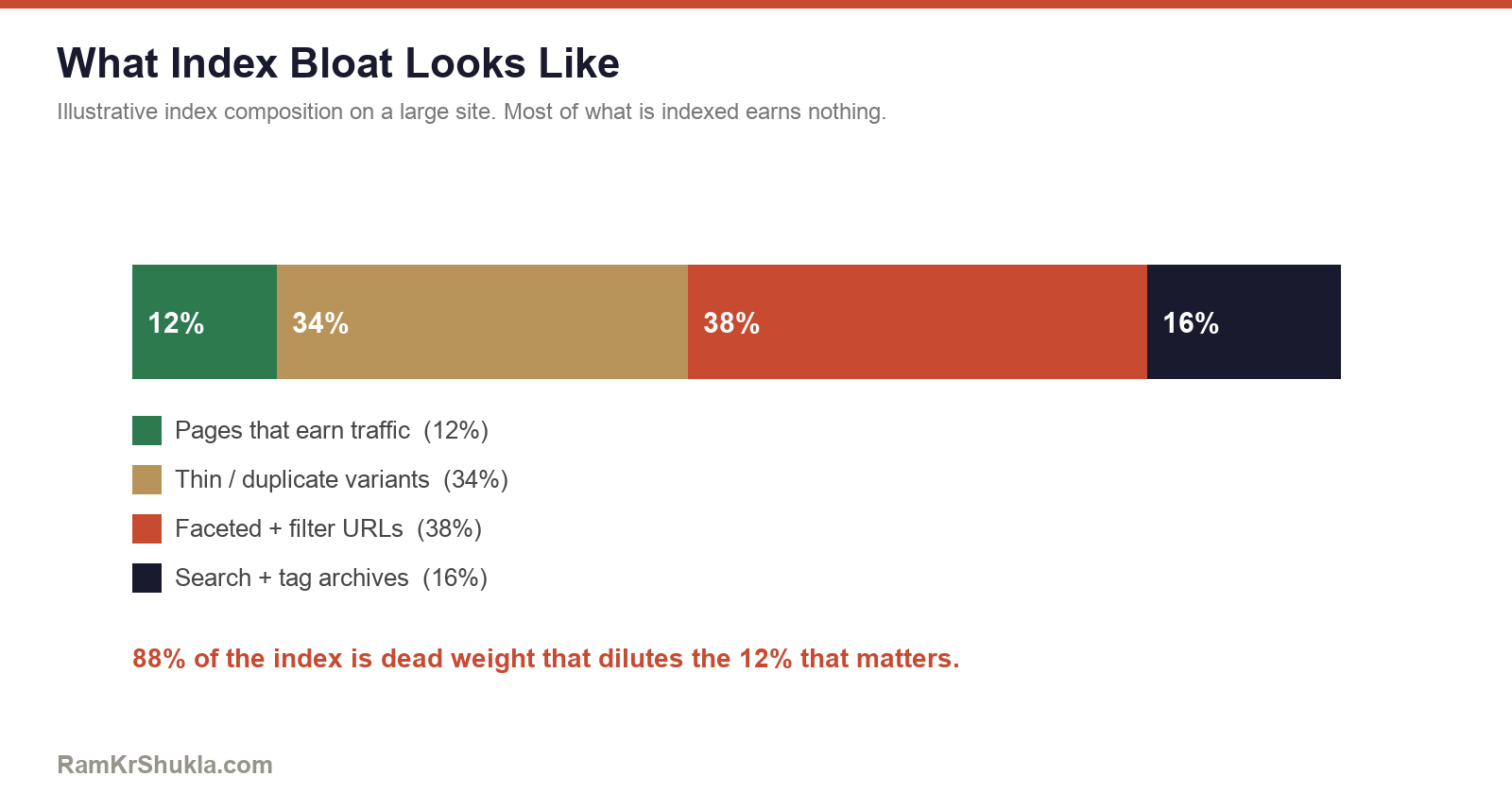
Large sites generate URLs automatically: filtered category views, faceted navigation, search result pages, tag archives, pagination, session parameters, and near-duplicate product variants. Left uncontrolled, Google crawls and indexes tens of thousands of them. On one marketplace I worked on, a huge share of indexed pages should never have been indexed at all. The cost is real and threefold.
“On a large site, deleting a hundred thousand pages can be the single best thing you do for the pages that remain. The discipline to prune is rarer, and more valuable, than the ability to publish.”
Ram Kr Shukla, SEO and Growth Consultant
The Controls That Fix It
Signs your site has an index bloat problem:
- A site: search in Google returns far more pages than you have real content for
- Search Console shows large numbers of crawled-not-indexed or discovered-not-indexed URLs
- Faceted or filtered URLs appearing in the index in large numbers
- New content taking a long time to get crawled and indexed
- Traffic flat despite a large and growing page count
The instinct when traffic is flat is to add more pages. If you have index bloat, that instinct makes the problem worse. The fix is subtraction first: prune the index to the pages that deserve to be there, concentrate crawl budget and authority on them, and only then consider what genuinely new pages are worth adding.
A Real Pattern at Scale
To make this concrete without naming the client: on one global marketplace I worked on, the indexed page count ran into the hundreds of thousands, while the pages that earned meaningful traffic numbered in the low thousands. The gap was faceted navigation and filter combinations, every colour, size, and sort order generating its own indexable URL, plus tag archives and internal search pages Google had happily crawled and stored. The store had not published that content deliberately. The platform generated it, and nobody had told Google to ignore it.
The fix was not more content, it was subtraction. Deciding which filtered views deserved to be landing pages and blocking the rest, canonicalising duplicate paths, and applying noindex to the archives and search pages. Reclaiming crawl budget and concentrating authority on the pages that could actually rank did more for the site than any content campaign of that period. On large sites, the highest-leverage SEO work is often deletion.
How to Run the Diagnosis Yourself
You do not need enterprise tooling to find out whether you have this problem. The check takes an afternoon.
The index bloat audit, step by step:
- Run a site: search for your domain and compare Google’s page count to your real content count. A large gap is the first flag
- In Search Console Page Indexing, read the excluded reasons: crawled-not-indexed and discovered-not-indexed climbing means demand-quality problems at scale
- Crawl the site and bucket URLs by type (on Shopify, throttle the crawler first so 429 errors do not fake broken pages): how many are faceted, filtered, tag, or search URLs versus real content
- Check how fast new content gets indexed. Slow indexing is a symptom of crawl budget spent elsewhere
- Map each junk URL type to a control: canonical, noindex, robots, or parameter handling, and prioritise the biggest buckets first
Crawl Budget: How Google Actually Spends Its Time on Your Site
Crawl budget is the amount of crawling Google is willing to do on your site, and on large sites it is finite. It comes down to two forces: how much Google can crawl without straining your servers, and how much it wants to crawl based on how fresh and valuable it judges your pages. Every request spent fetching a filtered URL that will never rank is a request it did not spend on a page that could. On a site of a few hundred pages this is invisible. On a site of hundreds of thousands, it is the ceiling.
You can see the problem in server logs and in Search Console. When a large share of crawl activity lands on parameter URLs, internal search pages, and endless filter combinations, while your genuinely important pages are crawled rarely, crawl budget is being spent on nothing. The symptom owners notice first is different, though: new content that takes weeks to appear in the index, because Google is busy re-crawling junk it was never told to ignore.
The Prune and Consolidate Playbook
Fixing bloat is not one action, it is a sequence, and the order protects you from removing something that was quietly earning. This is the playbook I run, biggest buckets first.
What Recovery Looks Like After a Prune
The first thing that improves is usually not rankings, it is crawl efficiency: important pages get crawled more often and new content gets indexed faster, because the budget is no longer wasted. Rankings follow over the next one to three months as the remaining pages absorb the internal authority once scattered across thousands of dead URLs. On the marketplace I described, reclaiming crawl budget and concentrating authority did more for the site than any content campaign of that period. The lesson holds: on a large site, the highest-leverage SEO work is often what you remove, not what you add.
Related reading: technical SEO before content, international SEO across markets, and the position 11-100 trap. This work sits inside my enterprise SEO and technical SEO services. Also worth reading: how to check your brand’s AI visibility in ChatGPT.
Suspect your site has too many pages working against it?
Crawl budget and index control are core to my technical and enterprise SEO work. I will show you exactly how much of your index is dead weight, and the plan to reclaim it.
Technical SEO ServicesEnterprise SEOTwo of the biggest sources of the bloat covered here have their own deep dives: faceted navigation SEO and pagination SEO.
Crawl budget is also spent by distance, not just volume: see crawl depth and flattening site architecture. Also relevant: automotive SEO and sold vehicle lifecycle handling. Also relevant: job board SEO.
Tags: Technical SEOCrawl BudgetIndex BloatEnterprise SEO