
Behind the Work. Shopify SEO Reporting
What a Real Shopify SEO Report Contains, and Why Most Are Useless
Most Shopify SEO reports are theatre. A screenshot of a rankings tool, a line that went up, a paragraph of jargon, and an invoice. They are designed to look like progress rather than to explain it, and they share one tell: they never connect the work to revenue, because connecting it would invite the question of whether it worked.
A real report does the opposite. It is a monthly instrument that tells the founder exactly what moved, what did not, why, and what happens next. I want to show you what that actually looks like, using the structure of a real monthly report for a large Shopify e-commerce brand in the home and lifestyle space. No client name, and the numbers here are illustrative rather than theirs. What matters is the anatomy, because the anatomy is what separates a consultant from a content mill, and because most Shopify e-commerce owners have never seen a report built to this standard.
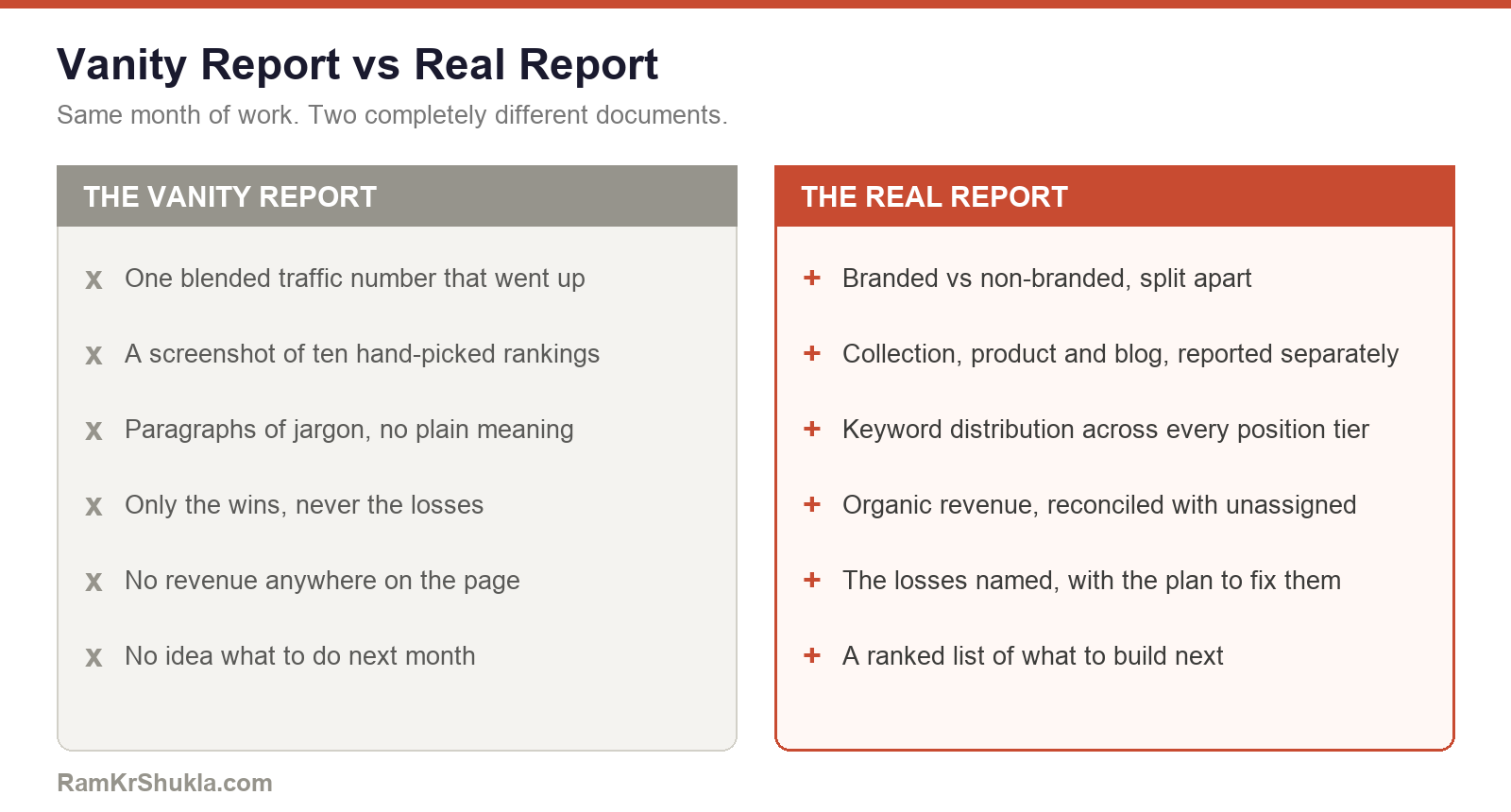
“A vanity report shows you the number that went up. A real report shows you the number that pays your salary, even in the month it went down.”
Ram Kr Shukla, SEO and Growth Consultant
The Eight Layers of a Report That Is Worth Reading
Why Shopify Reporting Has Its Own Traps
Shopify is a wonderful platform to sell on and a quietly awkward one to report SEO for, and a report that ignores its quirks will mislead you. Three traps show up on almost every store.
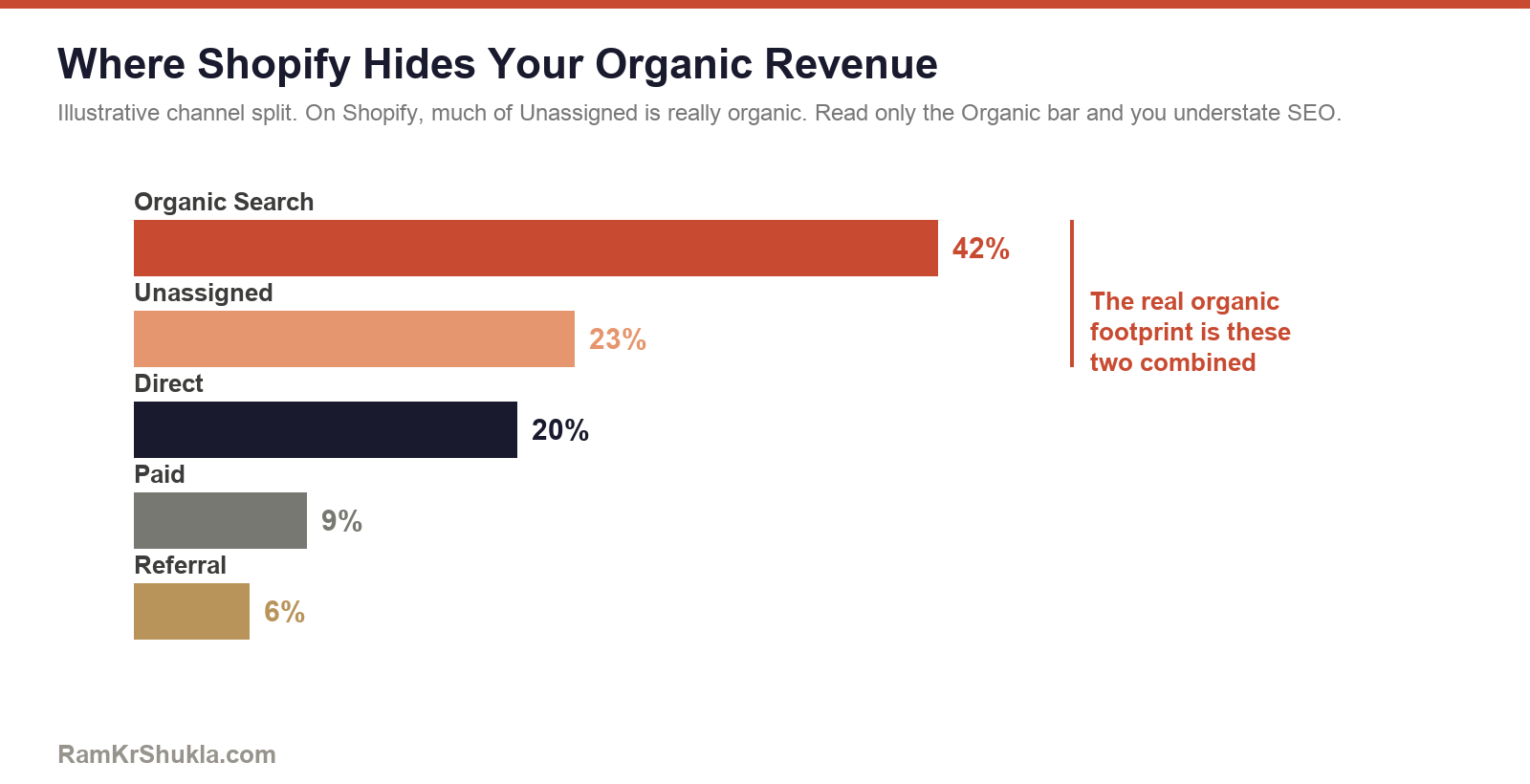
The unassigned revenue trap. A meaningful slice of what is genuinely organic revenue gets bucketed as unassigned in GA4 on Shopify stores, because of how the checkout and referral data flow. A lazy report reads the organic revenue line, sees it flat, and reports SEO as underperforming, when the truth is sitting one row down in unassigned. A real report reconciles the two, so your best channel is not quietly blamed for a measurement artefact. If the cart and checkout events themselves look wrong, the Shopify GA4 audit shows how to prove it in one test.
The collection-page ceiling. Shopify collection pages are your highest-value SEO surface, but the default theme treats them as a product grid with a title and nothing else: no intro copy, no supporting content, thin on the words Google needs. The report that matters tracks collection-page performance specifically and treats collection optimisation, real intro copy, FAQ content, footer text, internal links, as its own workstream. In the real report this anatomy is drawn from, the collection pages that improved were precisely the ones where footer content was added and meta tags were rewritten against Search Console keywords. That is not a coincidence. That is the lever.
The variant and URL trap. Shopify generates duplicate paths through collections, appends variant IDs to product URLs, and multiplies tag pages, all of which quietly split ranking signals if left unmanaged. A serious report includes the technical log where these get fixed, because on Shopify the technical housekeeping is not optional maintenance, it is a recurring source of ranking gains.
The Blog Engine Most Shopify Stores Ignore
Here is the part of the real report that surprises founders most. The single biggest growth driver over the reporting period was not the store pages at all. It was the blog. Blog traffic climbed many times over across a handful of months and, at its peak, was carrying more organic clicks than the collection pages that everyone assumes do the heavy lifting.
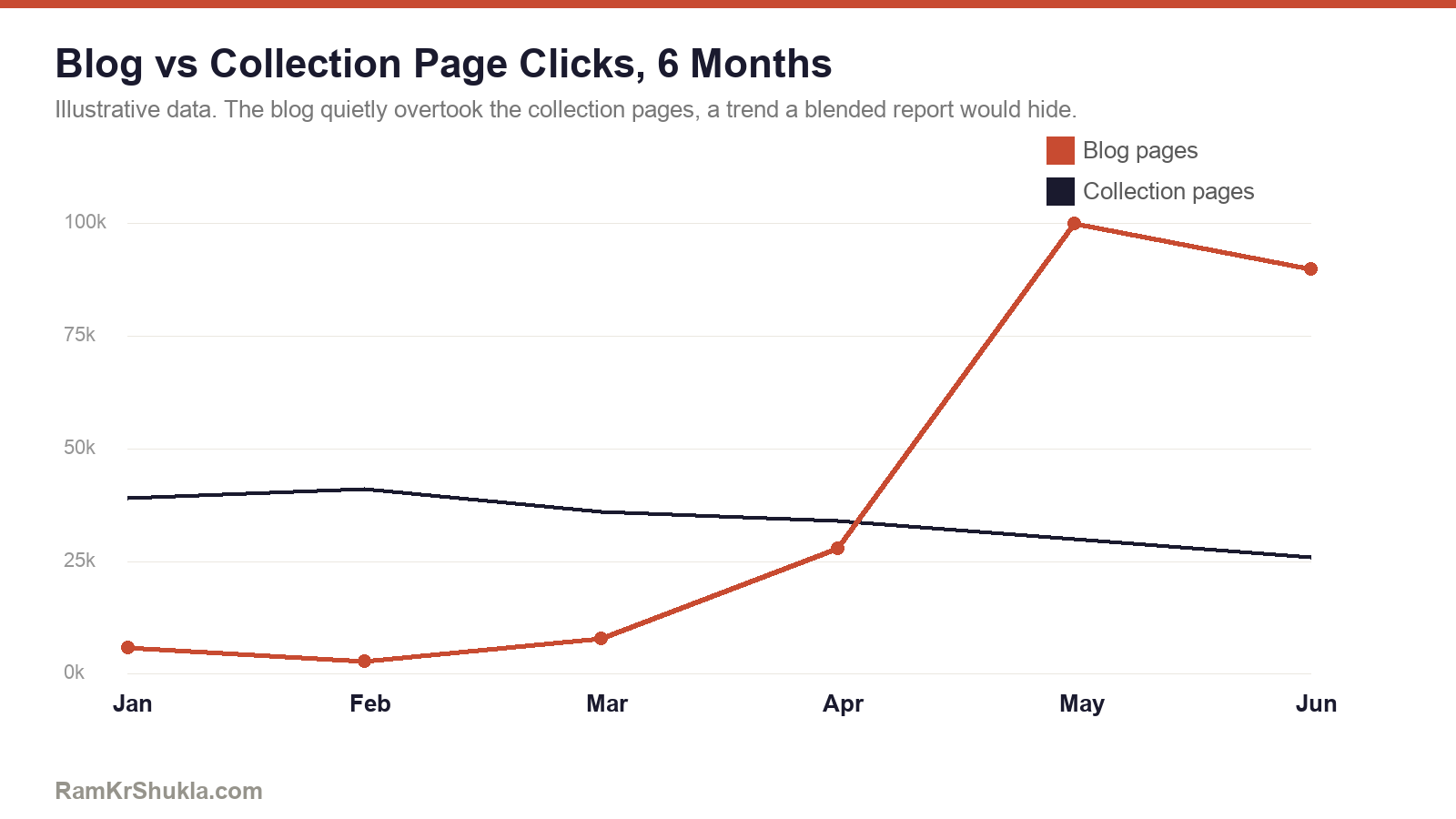
This is the Shopify SEO opportunity hiding in plain sight. Most stores treat the Shopify blog as an afterthought, a place for the occasional company update. Used properly it becomes a top-of-funnel engine: buying guides, how-to content, and category education that rank for the questions shoppers ask before they know which product they want, then route that attention into collection and product pages through internal links. A report that breaks out blog performance separately is the only way you would ever see this working, or know to invest more in it. Blend it into a single traffic line and the single most important trend on the store stays invisible.
The Real Test: What the Report Does in a Down Month
Any report looks fine when the line goes up. The month that reveals the consultant is the one where clicks fell. In the real report this anatomy is drawn from, total organic clicks dipped month over month, and here is what a serious report does with that.
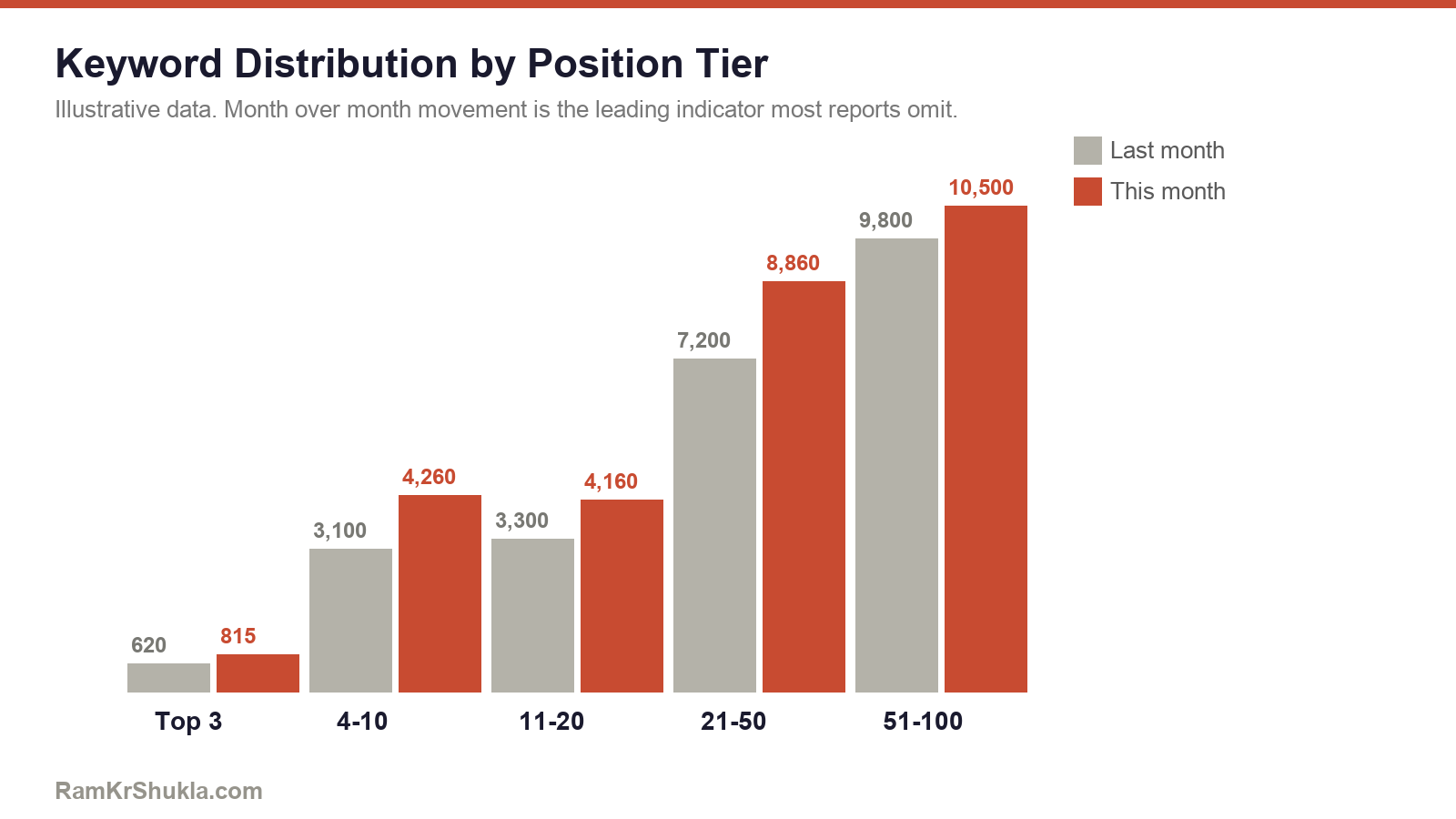
It does not bury the dip. It leads with it, then it decomposes it. Impressions actually rose that same month, which means the drop was not lost visibility but lost click-through, a different problem with different fixes: titles, meta descriptions, and rich results, not rankings. The competitor trend showed the whole category dipping together, pointing at seasonal demand rather than a penalty. Keyword distribution showed hundreds of terms climbing into higher position tiers even as clicks fell, which means the pipeline was filling while the current month softened. And the position data revealed a subtle truth every Shopify operator should internalise: terms moving from page three to page two register as a ranking gain but do not yet earn clicks, so the report was capturing momentum that the traffic line had not caught up to.
None of that is spin. It is the difference between a report that manages your emotions and one that manages your business. A down month explained honestly, with the leading indicators showing why the next months look strong, keeps a founder invested through exactly the period when a vanity report would have either panicked them or lied to them.
How to Judge the Shopify SEO Report You Currently Get
Open your last Shopify SEO report and check:
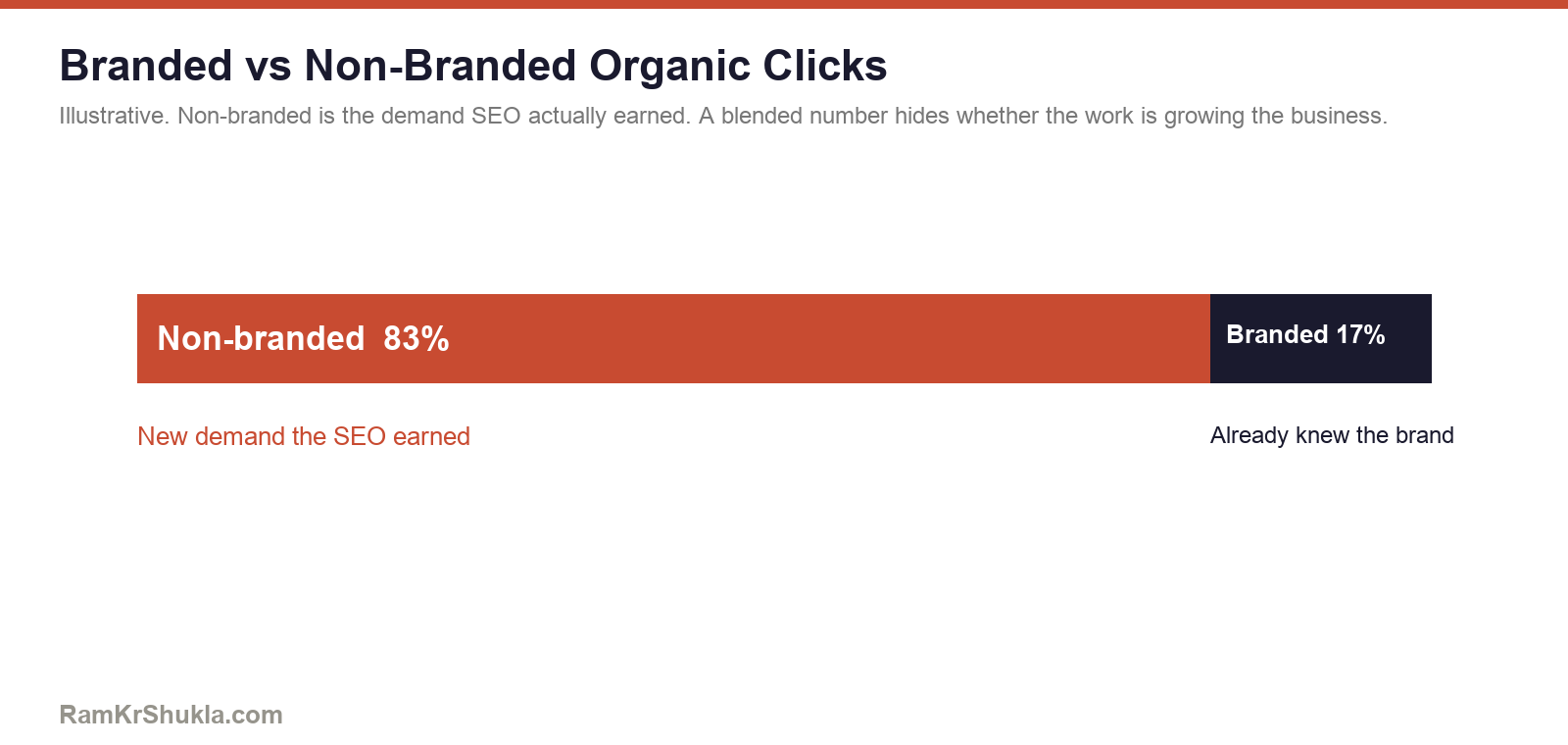
- Does it separate branded from non-branded traffic, or blend them into one flattering number?
- Does it report collection, product, and blog pages separately, the way Shopify actually works?
- Does it reconcile organic and unassigned revenue, or let SEO take the blame for the unassigned bucket?
- Does it show organic revenue at all, or stop at clicks and impressions?
- Does it name the keywords and pages that declined, or only the ones that improved?
- Does it list exactly what was done, dated, including the Shopify technical fixes?
- Does it tell you what to build next month, or only what happened last month?
If your report fails most of these, you are not being reported to. You are being managed. The work underneath might even be fine, but you have no way to know, and that not-knowing is the actual product a vanity report sells. A real report costs the consultant more effort and more exposure, which is precisely why the ones willing to produce it are worth having.
Want Shopify SEO that reports to revenue?
I run Shopify e-commerce SEO with this level of reporting built in: branded splits, collection-versus-product segmentation, revenue reconciliation, and an honest monthly read. Start with an audit and see exactly where your store stands.
Shopify SEO ServicesGet an SEO AuditTags: Shopify SEOE-Commerce SEOSEO Reporting