
Enterprise SEO. Field Notes From a Global Marketplace
The Position 11-100 Trap: Why Enterprise Sites Rank for Everything and Get Traffic From Nothing
A few years ago I led the SEO strategy for a global used-vehicle marketplace operating across four markets: four markets across Latin America, Europe, and Asia. Multiple domains, multiple languages, a progressive web app, and millions of monthly impressions. On paper it looked like an SEO success story. It ranked for tens of thousands of keywords in every market. The dashboards were enormous.
Then you looked one level deeper and found the same quiet catastrophe in all four countries. I want to walk through it here, anonymised and with illustrative numbers rather than the client’s, because it is the single most common and most misunderstood problem on large sites, and almost nobody writes about it honestly.
Ranking for Everything, Getting Traffic From Nothing
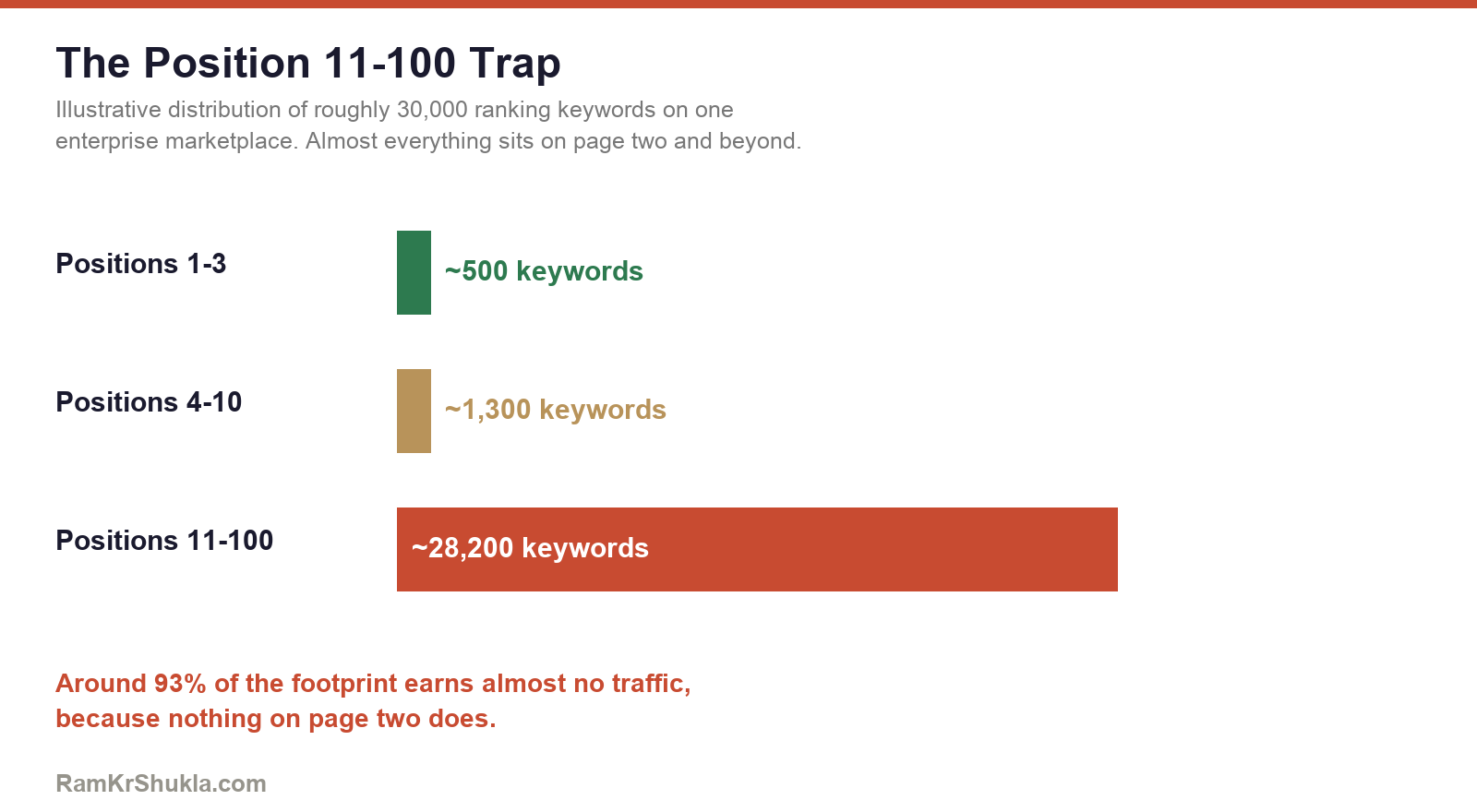
Here was the pattern, repeated in every single market. The site ranked for somewhere between twenty-five and forty thousand keywords. Of those, a few hundred sat in positions one to three. A thousand or two sat in positions four to ten. And the overwhelming mass, twenty-thousand-plus keywords per market, sat in positions eleven to one hundred. Page two and beyond, where click-through rates round to zero.
The one-line summary I wrote against every market in that strategy deck was the same sentence: we are not capturing the traffic opportunity that already exists, because our rankings are not high enough to earn clicks. That is the trap. A site can look like an SEO giant in a rank tracker and behave like a ghost in the analytics, and the gap between those two views is thousands of keywords stuck one page too low to matter.
“Ranking for thirty thousand keywords sounds like success until you learn that twenty-eight thousand of them sit on page two, where the traffic does not live. A big footprint is not a big channel.”
Ram Kr Shukla, SEO and Growth Consultant
Why Enterprise Sites Fall Into This
Large sites, and marketplaces especially, generate pages at industrial scale. Every listing, every category, every filter combination, every location becomes a URL. Google discovers and ranks a huge number of them, but ranks most of them weakly, because the site never gave any individual page the signals it needed to climb. The footprint grows automatically; the authority to rank it does not. So you end up broad and shallow: present everywhere, strong nowhere.
The Fix: Technical First, Content Second, Never the Other Way
The instinct on a site like this is to write more content. That instinct is wrong, and expensively so. When twenty-eight thousand keywords are stranded on page two, the problem is almost never a shortage of pages. It is that the pages you have cannot climb, because the technical foundation underneath them is broken. So the strategy sequenced hard: fix the machine first, then feed it.
The Backlog Nobody Sees, and the Order That Matters
A real enterprise SEO strategy is not a document of ideas. It is a prioritised backlog of dozens of specific technical initiatives, each tagged by theme, owner, and quarter, shipped in sequence. Structured data, facet optimisation, pagination, breadcrumb restructuring, URL rebuilds, hreflang, the internal linking scheme, and a long tail of page-speed work from image decoding attributes to Brotli compression. Unglamorous, every one of them, and collectively the thing that lifts a stranded footprint off page two.
The order is the strategy. Fix indexing before you build content, or the new content joins the twenty-eight thousand pages nobody sees. Fix cannibalisation before you chase rankings, or you keep splitting your own signal. Fix speed before you scale, or every new page inherits the same ceiling. On a large site, sequencing is where consultants earn their fee, because doing the right things in the wrong order produces motion without progress.
What This Means for Your Site, Even If You Are Not a Marketplace
You do not need four markets and a progressive web app to be in the position 11-100 trap. Any site that has grown past a few hundred pages can have it: an e-commerce catalogue, a large blog, a programmatic content play, a directory. The diagnostic is simple and you can run it this week. Pull your ranking keywords, bucket them by position tier, and look at the shape. If they come from Search Console, pull each one with its own exact-match call first, or the high-impression head terms drop out of the API response. If the eleven-to-hundred bucket dwarfs everything above it, you are not under-ranked because you lack content. You are under-ranked because your existing pages cannot climb, and more content will make it worse, not better.
The fix is the same at every scale: technical foundation first so pages can rank, prioritisation second so you push the keywords closest to page one and worth the most, and only then content, aimed at the gaps that actually convert. That sequence is the difference between a rank tracker that looks impressive and an analytics dashboard that pays the bills.
Is your site ranking for everything and getting traffic from nothing?
I run enterprise, marketplace, and international SEO with exactly this diagnosis at the centre: position distribution, index control, and the technical sequencing that lifts a stranded footprint. Start with an audit that shows you the shape of your own trap.
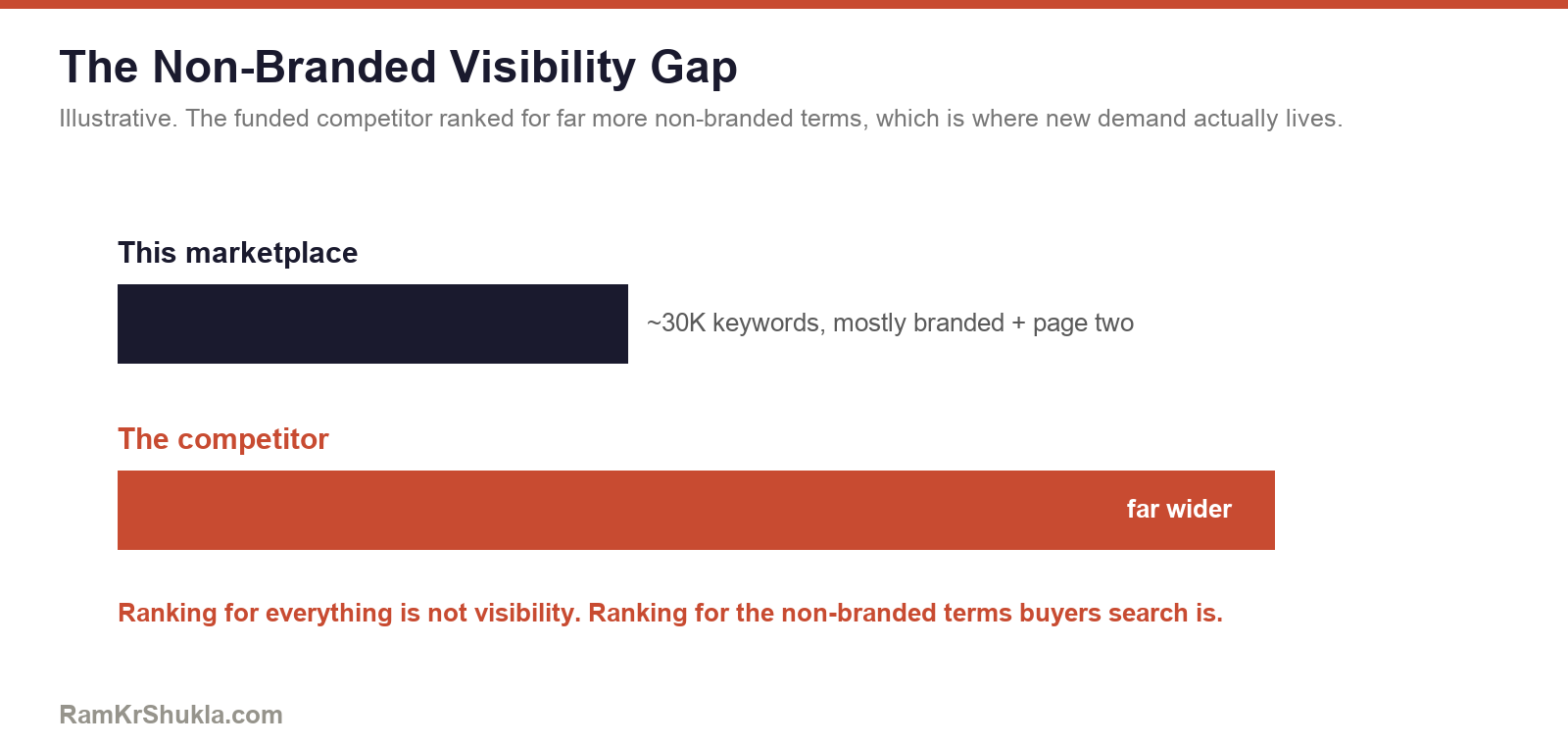
Technical SEO ServicesInternational SEOMost of those stranded page-two keywords are non-branded, which is exactly why they matter: see branded vs non-branded traffic.
Marketplace search runs on different rules from Google: see how Amazon search actually ranks products.
This pattern is most acute on large catalogues: see marketplace and classifieds SEO and automotive SEO. Also relevant: job board and careers platform SEO.
Tags: Enterprise SEOTechnical SEOInternational SEOMarketplace SEO