|
120K Monthly Organic Visitors |
9% Brand Conversion Rate |
14 mo Time to Results |
A practical Shopify SEO case study on the architecture decisions, content fixes, and structural work that made sustainable organic growth possible — without shortcuts or tricks.
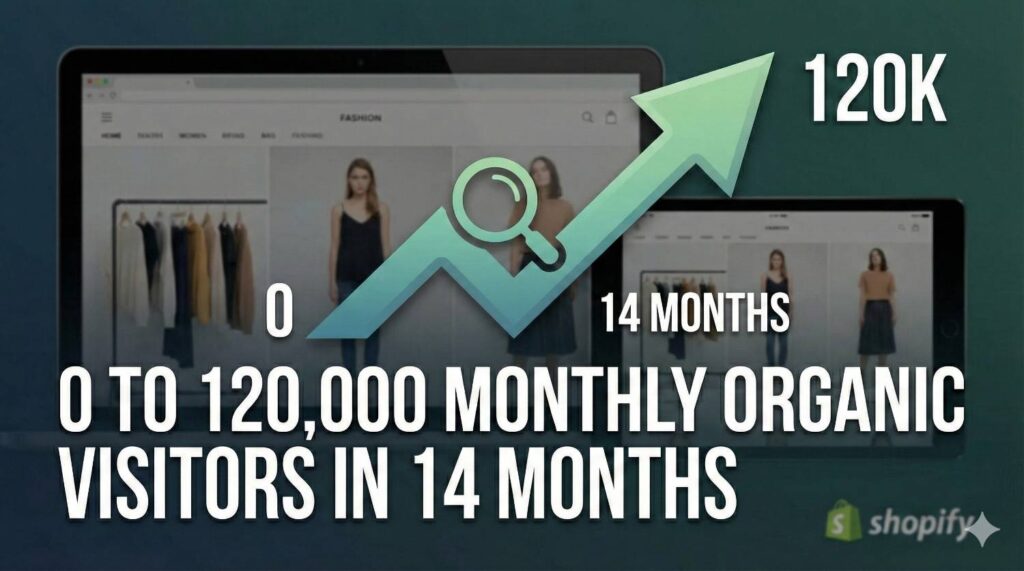
Organic traffic growth across the 14-month engagement
Scaling organic traffic for a fashion brand is rarely clean or linear. The industry moves fast, competition is unforgiving, and the way customers actually search looks nothing like what store owners expect. Layer Shopify’s structural tendencies on top — URL bloat, variant duplication, app-generated pages — and most stores end up stuck before they’ve even started.
This project began in exactly that position. A leading fashion brand on Shopify. Over 200,000 URLs in the index. Zero meaningful organic traffic. Real inventory, real ambition, and no search visibility to show for any of it.
Fourteen months later, the same store was pulling 120,000 monthly organic visitors, converting at 9% on brand queries and 2.6% on non-brand, and competing with established category leaders in organic search. Here’s a clear-eyed account of how that happened.
Shopify is a genuinely good platform for running an online store. But it consistently generates far more URLs than any crawl budget can justify — and most merchants don’t realize this until the damage is already done.
By the time the first technical audit was complete, the store’s crawlable index looked like this:
Before chasing rankings, the priority was controlling what Google was actually seeing. At that point, Google was seeing chaos — and indexing very little of it.
Fashion brands almost universally underinvest in product copy. Descriptions tend to be a few words — sometimes just a color and material, often nothing more than a truncated line from the manufacturer. Google responds predictably: it allocates minimal crawl budget, indexes selectively, and rarely ranks pages that offer nothing beyond what competing stores already show.
When 70–80% of a site’s inventory pages are essentially duplicate shells, the whole domain suffers — not just the individual thin pages.
What changed with product content
The goal wasn’t to pad pages with words. It was to give both customers and search engines enough to make sense of each product. Once indexing stabilized, impressions in Google Search Console started climbing — slowly at first, then with real momentum.
Fashion shoppers don’t search the way store owners expect. They rarely type in a product name or SKU. They search for categories, occasions, and contexts — “black maxi dress,” “summer tops for women,” “high-waist trousers,” “party wear gowns.” This traffic carries enormous commercial intent, and all of it lands on collection pages, not individual products.
If your collection pages are weak, no amount of product-level SEO will compensate. So collection pages became the primary focus of the entire strategy.
What went into each collection page
Within a few months, category pages were pulling organic traffic that product pages never could on their own. Over time, collection pages became responsible for over 70% of all organic revenue from the site.
When a store carries thousands of products across dozens of categories, search engines need help understanding how everything relates. Without a clear structure, Google treats each page in isolation — and pages in isolation rarely rank for anything competitive.
Screaming Frog was used to map the entire internal linking structure, then rebuilt it with intent.
Clusters built for this brand
Each cluster followed a clear hierarchy: main collection → sub-collection → individual product → supporting blog content. This structure signals depth and topical completeness — two things Google consistently rewards in competitive categories.
One of the more surprising findings in the audit was how deep important pages were buried. Some of the brand’s best-selling collections sat five or six clicks away from the homepage. That depth sends Google a clear signal: these pages are not important. Crawl budget gets rationed accordingly, and rankings follow.
Structural fixes that moved the needle
Within a few months, priority collection pages sat comfortably at depth one or two. Google crawled faster, indexed more completely, and began ranking pages that had previously been invisible.
Fashion content planning often stops at the editorial calendar — festive season, spring/summer, sale, repeat. That approach misses most of the organic opportunity. SEO growth requires evergreen, seasonal, and trend-driven content working together, with each piece reinforcing the site’s topical authority.
What the content calendar included
Every piece of content was built to internally link back to relevant collection pages — reinforcing clusters, strengthening topical relevance, and giving Google additional signals about what this brand covers authoritatively.
Fashion e-commerce is image-heavy, app-heavy, and often built on themes that weren’t designed with crawlability or page speed in mind. The technical debt compounds quietly until it becomes a ceiling on what content and structural work can achieve.
Technical fixes completed during the engagement
None of this is glamorous. But technical stability is what allows content and structural improvements to actually perform.
Traffic didn’t spike. It built steadily, with each phase of work raising the ceiling for what came next.
|
Monthly Organic Visitors 120K From zero at project start |
Brand Conversion Rate 9% High-intent brand traffic |
|
Non-Brand Conversion Rate 2.6% Category-level traffic converting |
Organic Revenue via Collections 70%+ Collection pages drove majority of revenue |
This project reinforced something most teams only discover after months of frustration: Shopify SEO is not won through clever tactics or tool hacks. It’s won through structure.
— Ram Kr. Shukla, SEO & Growth Consultant
Once the architecture is clean, the compounding effect is real. Collection pages start ranking faster. Product pages get indexed more reliably. Blog content reinforces category authority. Internal links elevate entire clusters. Google extends trust across the domain rather than evaluating each page in isolation.
That’s the difference between organic growth that happens by accident — and organic growth that becomes predictable, scalable, and tied directly to revenue.
If your Shopify store is in a similar position — real products, real ambition, but search visibility that doesn’t reflect either — the answer is almost certainly structural before it’s anything else.

SEO & AI Growth Consultant
18+ years across SEO, programmatic media, and performance marketing. Partner to founders and CMOs scaling B2B, SaaS, and e-commerce brands through data-driven organic growth strategies.
Is Your Shopify Store Sitting on Untapped Search Potential?
Let’s spend 30 minutes reviewing your SEO setup, identifying structural gaps, and outlining exactly where your growth is being held back.
Schedule a Free Growth Call